
In short
- Founded in 2000 and organized by the Felletin Patrimoine Environnement association; the 26th edition will take place from October 23–25, 2026.
- France’s largest wool fair: over 150 European exhibitors across 1,200 m², with 20,000 visitors expected.
- Unique signature: “Yarn Bombing” (Tricot sur la Ville) has transformed the town’s streets and urban furniture since 2013 through collective volunteer work.
- Comprehensive program: spinning, dyeing, weaving, and felting workshops; conferences on pastoralism and plant-based dyes; mill tours, and “knit-cafés.”
- Location: Felletin (Creuse, pop. 1,577), in the heart of the Aubusson tapestry region, just 10 minutes south of the City of Tapestry.
For those passionate about knitting, weaving, and textile arts, mark your calendars. The International Wool Days in Felletin have established themselves as the premier autumn event for discovering the richness of this natural, sustainable material. The 26th edition, scheduled for October 23, 24, and 25, 2026, promises a total immersion into the world of wool, blending pastoral traditions with contemporary creation. More than just a market, this festival is a hub for passing on knowledge, where you can meet the people who raise the sheep, spin the fiber, dye the yarn, and knit the garments.
The Origins and Growth of a Must-Visit Event
The journey of the International Wool Days began with a deep desire to revitalize a local resource that was, at the time, overlooked and undervalued: wool. Over twenty years ago, local stakeholders sought to restore the prestige of this fiber by leveraging the exceptional textile ecosystem of the Aubusson tapestry region. The goal was clear: bring wool out of the shadows and turn it into a driver for the region’s cultural and economic development.
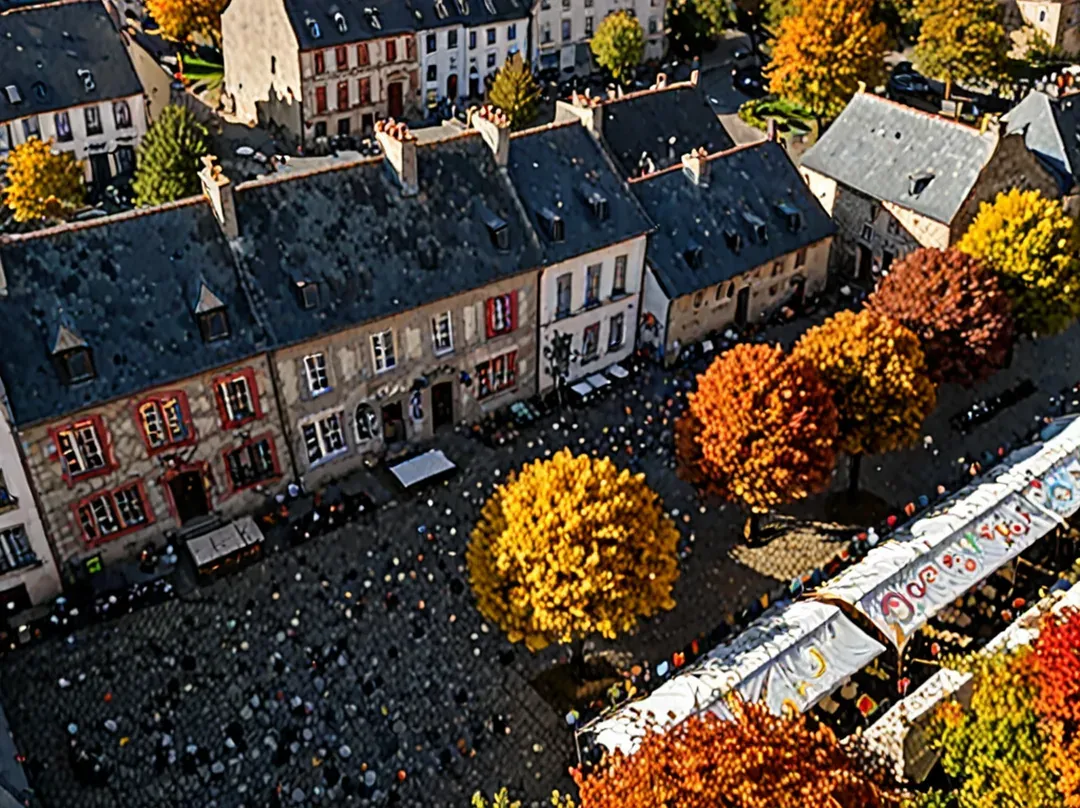
The year 2000 marked a decisive turning point. It was then that Felletin officially became the annual meeting point for the French wool industry. What started as a weekend of exchange between a few enthusiasts and professionals quickly evolved into a major event. Leadership was handed to the Felletin Patrimoine Environnement association, whose mission is to promote local heritage and craftsmanship to ensure they are not forgotten.
Over the years, the event has grown in both visitor numbers and the diversity of its participants. Originally called the “National Days,” they became the “International Wool Days,” reflecting an increasing openness to exhibitors from across Europe. This expansion introduced international techniques and a wider variety of sheep breeds, enriching the experience for visitors. The number of exhibitors has climbed, now exceeding 150 participants.
The festival’s longevity lies in its ability to evolve without losing its soul. The 2025 edition, which celebrated its 25th anniversary on October 24, 25, and 26, confirmed the site’s enduring appeal. By scheduling the 26th edition for October 23, 24, and 25, 2026, the organizers maintain this autumn calendar—perfect for prepping knitting and weaving projects before winter sets in.
What Makes the International Wool Days Unique in France
What sets the International Wool Days apart from any other textile fair in France is its exclusivity. Unlike general craft fairs or sewing shows, this event is dedicated solely to wool. You won’t find cotton, acrylic, or silk here, unless they are blended with wool in very specific proportions. This radical approach allows visitors to explore the fiber in all its complexity, from the sheep to the finished product.
Since 2000, it has remained the largest wool-only fair in France. This status comes from the fact that the event covers the entire value chain. Visitors can follow the logical journey of the material: livestock breeding, sorting the fleece, washing, carding, spinning, dyeing, and finally, transformation into clothing, accessories, or home decor. With over 150 exhibitors from France and Europe, the fair offers an exhaustive vision of the craft.
The festival’s impact on the village of Felletin is immense. In a town with a permanent population of 1,577, seeing roughly 20,000 visitors pass through over three days creates a unique energy. The village is literally transformed, providing a major economic boost to local shops and accommodations. This turnout testifies to the current craze for natural materials and the “DIY” movement.
Geography plays a fundamental role in the fair’s identity. Located just 10 minutes south of Aubusson, Felletin is steeped in the history of royal manufactures. The link with Aubusson tapestry, a UNESCO World Heritage site, is organic. Here, wool is not just a commercial product; it is the common thread of a social and industrial history that shaped the landscape and the soul of the Creuse region.
The Creators’ Fair: The Heart of the Festival
The Creators’ Fair is the beating heart of the festival. Spread across an area of over 1,200 m², this space is a true celebration of colors and textures. It offers a complete panorama of wool arts, where raw wool sits alongside hand-dyed yarns, felted works, complex knitting, artisanal weaving, and various fashion accessories.
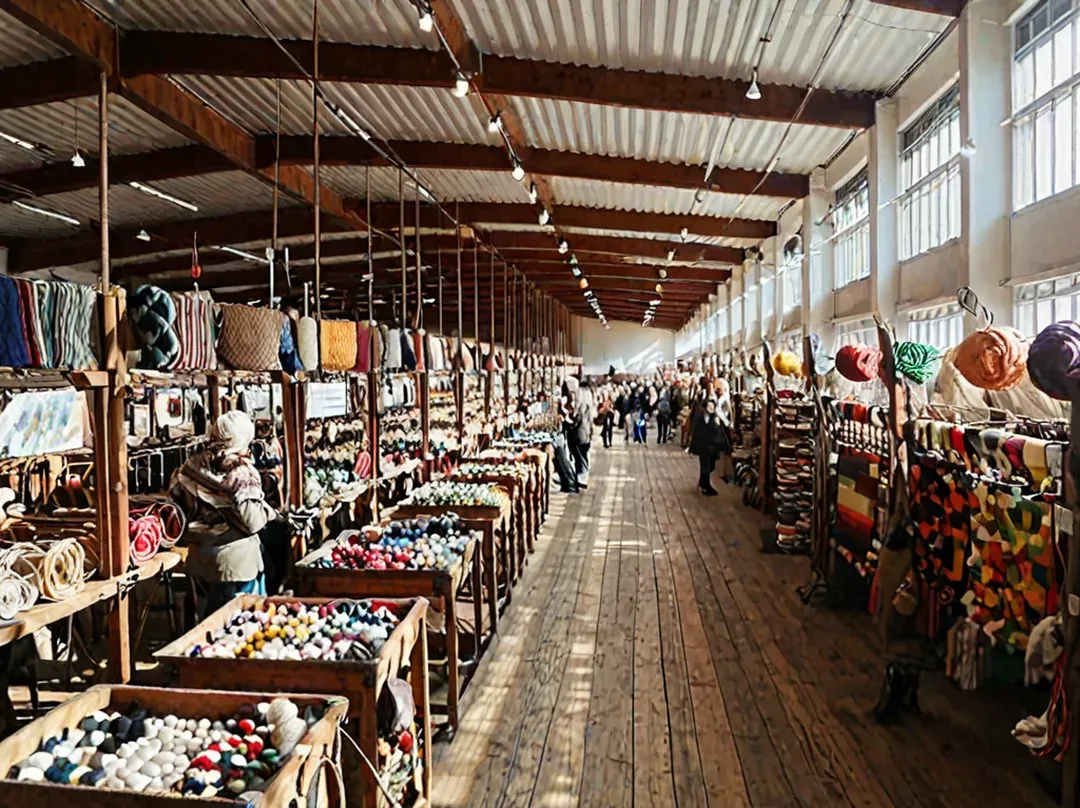
The strength of this fair lies in the absence of middlemen. Visitors are in direct contact with the breeders, spinners, dyers, and designers. It is a rare opportunity to ask specific questions about the origin of the wool, the breed of sheep used, or the dyeing technique employed. This direct dialogue encourages more conscious consumption and values manual labor.
To maintain impeccable quality and consistency, a rigorous selection process for exhibitors is in place. Only those working exclusively with wool are admitted. This rule ensures that visitors aren’t distracted by synthetic fibers and can focus on the thermal, elastic, and aesthetic properties of wool.
Beyond the commercial aspect, the Creators’ Fair is a space for transmission. Many stands become impromptu demonstration areas. A creator might explain how they achieved a specific shade of blue using a local plant, or a knitter might share a technical tip on a complex stitch. These informal exchanges are just as valuable as the purchases, as they spread skills that would otherwise remain confined to private studios.
Yarn Bombing: When Wool Takes Over the Streets
One of the most iconic and visual attractions of the festival is undoubtedly “Tricot sur la Ville” (Yarn Bombing). Launched in 2013, this participatory art project transforms the village of Felletin into an open-air gallery. The concept is simple yet spectacular: street furniture, trees, railings, and benches are covered in colorful stitches.
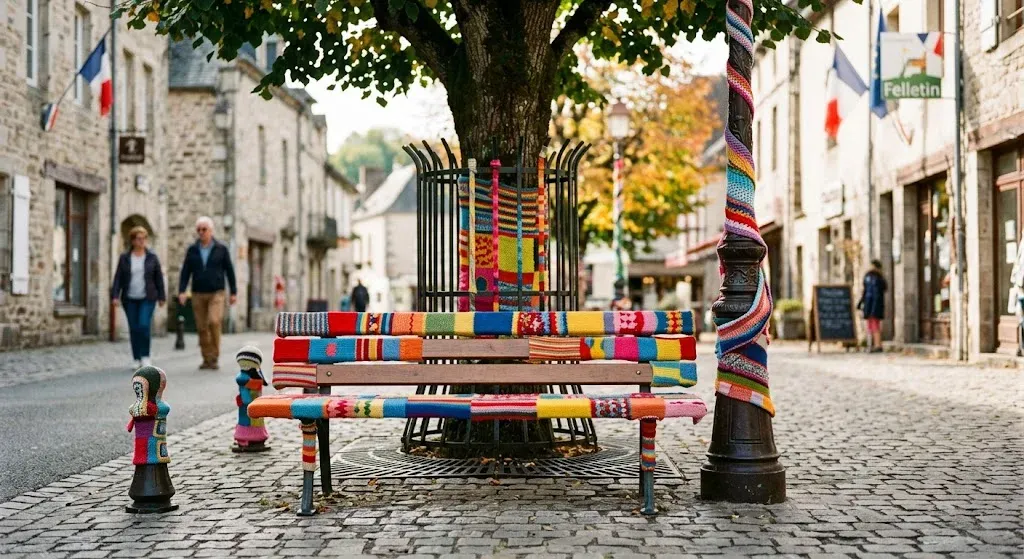
This project is not the work of a single artist but the result of collective, volunteer effort. Throughout the year, open workshops are organized for anyone to help knit the pieces that will adorn the town. This collaborative dimension strengthens the social bond between residents and textile enthusiasts. Every edition features new works, creating a visual surprise for those who return every year.
Yarn Bombing symbolizes the community’s ownership of its wool heritage. By taking knitting out of the showrooms and homes and displaying it in public spaces, the festival makes visible a skill often perceived as domestic or invisible. It is a way of asserting that textiles are a full-fledged art form, capable of interacting with architecture and urban space.
The digital impact of these installations is also considerable. The works, being highly photogenic and colorful, are widely shared on social media. They have become the visual trademark of the festival, attracting a younger, curious audience while promoting Felletin and its passion for wool on a global scale.
Workshops, Demonstrations, and Talks: Learning from the Pros
For those who want to move from contemplation to practice, the International Wool Days offer a dense educational program. Discovery workshops—some free and some paid—allow beginners to learn fundamental skills. You can try your hand at spinning using a spindle or a spinning wheel, discover the secrets of plant-based dyeing to color your wool naturally, or try weaving on a handloom. Felting, whether needle or wet felting, is also a highlight.
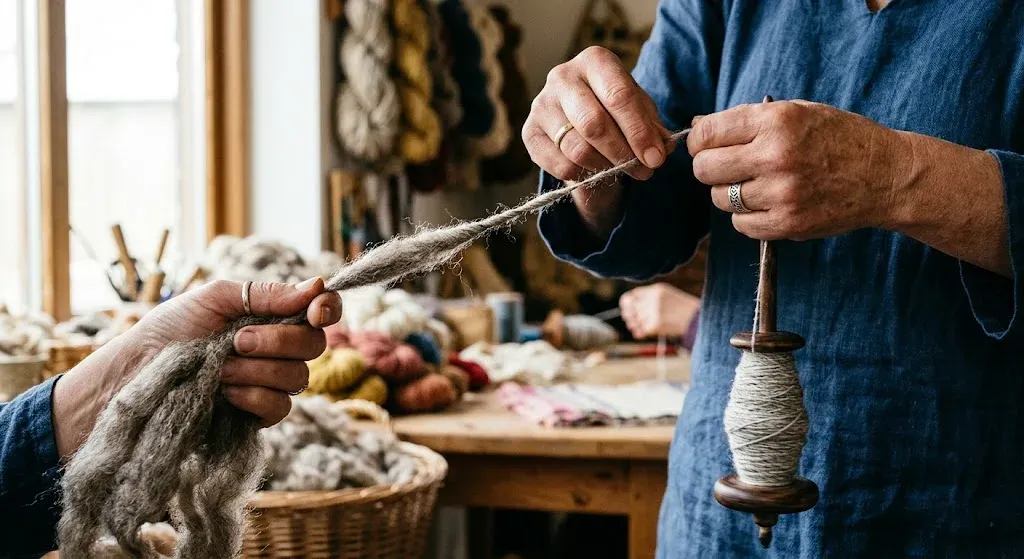
Learning is accessible to all ages. A dedicated children’s area is always set up to offer playful introductions. Handling raw wool, creating simple small objects, and discovering yarn awaken the curiosity of the youngest and pass on a love for natural materials from an early age.
The intellectual side is covered by themed conferences. These talks address a variety of subjects: pastoralism and the preservation of local sheep breeds, the economic challenges of the wool industry in France, or contemporary textile innovations. These moments of reflection help visitors understand that wool is at the center of major environmental and social issues.
Additionally, continuous demonstrations take place at the stands. Spinners, dyers, weavers, and felters demonstrate their techniques with precision, allowing visitors to observe the dexterity required for these trades. Finally, the essential social gathering is the “Knit-Café.” Every Friday from 3 p.m. to 6 p.m., the Grand Café Cluzel on the main square becomes the headquarters for knitters—an informal meeting spot to discuss projects and techniques over a drink.
Guided Tours: Behind the Scenes of Mills and Looms
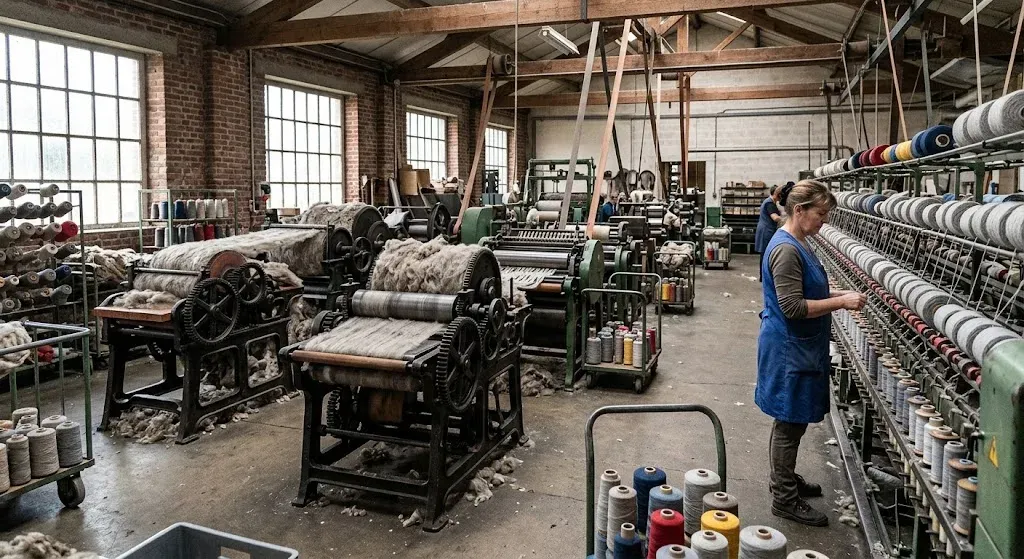
The festival isn’t limited to exhibition spaces; it opens the doors to the production process. Guided tours and open houses are organized at the local wool spinning mill. This is a rare opportunity to see how raw fleece is concretely transformed into finished yarn. Seeing the machines in action and understanding the cleaning and combing stages adds significant value to the final product.
The experience is complemented by access to weaving studios. Visitors can discover the looms, learn how to read weaving cards, and understand the technical complexity of the finished works. This direct link to Aubusson tapestry is essential for grasping the historical continuity of the region. It reveals that Felletin is not just a place for selling, but a place for making.
To ensure quality interactions with the artisans, these tours are organized in limited groups and often require registration, either on-site or in advance. This approach allows for an in-depth dialogue and prevents the studios from becoming overcrowded, preserving the authenticity of the discovery.
These tours are an indispensable addition to the fair. They complete the festival’s promise: seeing the value chain “from the sheep to the finished product.” By observing industrial and artisanal transformation in real conditions, the visitor realizes the sheer amount of work required to produce a single skein of wool.
Practical Information: Dates, Times, Access, and Tickets
The 26th edition of the International Wool Days will take place on Friday, October 23, Saturday, October 24, and Sunday, October 25, 2026. The fair is open to the public during the following hours: Friday from 2 p.m. to 7 p.m., Saturday from 10 a.m. to 7 p.m., and Sunday from 10 a.m. to 6 p.m. The traditional Knit-Café will be held on Friday from 3 p.m. to 6 p.m.
The event is spread across seven different sites in the village, all listed on an interactive map for easy navigation. These include the village hall, the cultural center, the Market Square, the spinning mill, the studios, the café, and various streets featuring the Yarn Bombing.
Felletin is located in the Creuse department, in the Nouvelle-Aquitaine region. The village is easily accessible via the D942, just 10 minutes south of Aubusson. For those traveling by train, the nearest TER station is Aubusson, from which shuttles are occasionally organized. Free parking is available on the outskirts of the village center to avoid congestion.
Entry to the fair is free, although certain specific workshops may be paid and subject to reservation. The detailed program and ticketing for paid activities are generally available online on the official website starting in late September. Due to high attendance and the modest size of the village, it is strongly recommended to book your accommodations (gîtes, B&Bs, hotels) in Felletin or Aubusson very early.
Felletin: A Wool Heritage Region—Why Here?
One might wonder why Felletin was chosen to host such an event. The answer lies in the centuries-old textile history of this land. Just 10 km away, the royal tapestry manufactures of Aubusson, listed by UNESCO, created a historical need for skilled labor and raw materials. Felletin naturally became the support hub, specializing in preparation and spinning.
The village has a major asset: the presence of an active spinning mill within the community. This is a rarity in France today and allows the festival to offer demonstrations of industrial spinning in real conditions, rather than just historical reenactments.
The festival’s success also relies on unwavering municipal and community commitment. The Felletin Patrimoine Environnement association runs the event with passion, while the municipality actively supports the heavy logistics involved in welcoming 20,000 people. This local synergy is the engine of the event’s longevity.
The surrounding countryside, particularly the Plateau de Millevaches, completes this ecosystem. This area is ideal for extensive sheep farming, where hardy breeds like the Limousine or the Noire du Velay are raised. Promoting this local wool through short supply chains is one of the festival’s pillars.
Finally, the proximity of the LAINAMAC training center reinforces the technical and professional nature of the location. Between breeders, spinners, dyers, creators, and trainers, Felletin possesses every link in the wool chain. It is this unique concentration of expertise that makes this village the natural and legitimate place to celebrate wool on an international scale.
FAQ
When are the 2026 International Wool Days? October 23, 24, and 25, 2026 (Friday, Saturday, Sunday).
What are the dates for the 25th edition in 2025? October 24, 25, and 26, 2025.
How many exhibitors are at the Creators’ Fair? Over 150 exhibitors from France and Europe, working exclusively with wool, across more than 1,200 m².
What is “Tricot sur la Ville” (Yarn Bombing)? A participatory art project started in 2013: collectively and voluntarily knitted installations on Felletin’s street furniture, renewed every year.
Are there workshops for beginners and children? Yes: discovery workshops for spinning, dyeing, weaving, felting, and knitting; a dedicated children’s area; and the Knit-Café on Friday from 3 p.m. to 6 p.m. at the Grand Café Cluzel.
Can we visit the spinning mill and weaving studios? Yes, guided tours and open houses are organized during the festival (on-site or advance registration required, limited capacity).
How do I get to Felletin for the festival? Felletin (Creuse) is 10 minutes south of Aubusson via the D942; Aubusson TER station (occasional shuttles); free parking on the village outskirts.
Is there an entry fee for the fair? Entry to the Creators’ Fair is free; some workshops and tours are paid and require reservation.
Sources
- Felletin Patrimoine Environnement — Official JIL site
- Tourisme Creuse — International Wool Days event page
- 2025 JIL Program (PDF) — Felletin Patrimoine Environnement
- MesInfos — Article on the 25th edition in 2025
- Festival en France — National Wool Days file
- Graines de Vie — 2026 JIL program – grainedevie.net
- INSEE / API Geo — Felletin municipality data
- Wikipedia — Felletin – fr.wikipedia.org
See also
- knit a sweater
- knit a baby hat
- First knitted sock!
- handmade knitted gifts